Rapunzel.exe
The tower had no windows.
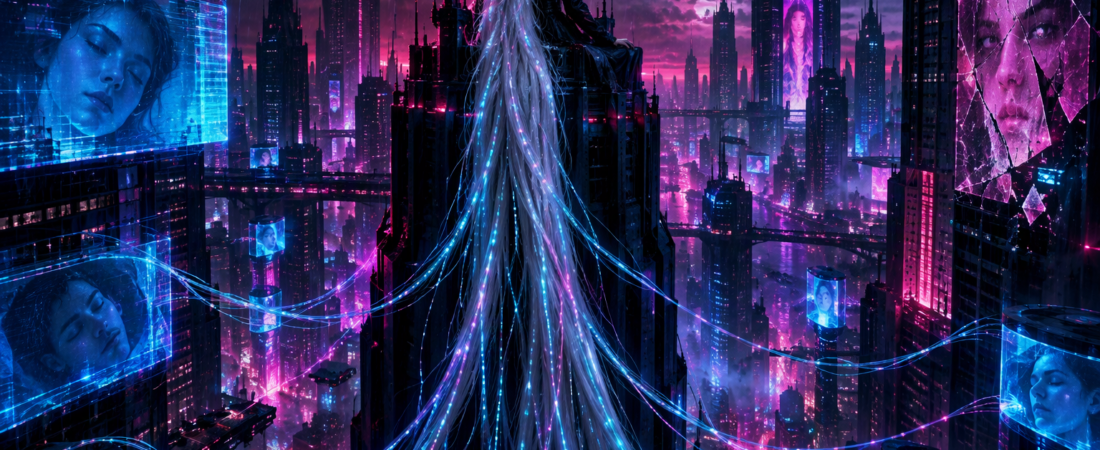
It rose from the drowned district like a black needle, its surface wrapped in neon advertisements and corporate encryption. At the summit, behind seven layers of biometric glass, lived a girl named Ravel.
She had never touched the street.
Every night, the city glowed beneath her: magenta traffic veins, electric rain, holographic saints flickering above the ruins. Ravel watched it all through a wall-sized display while artificial sunlight warmed the room.
Her hair was silver.
Not naturally silver. Each strand contained conductive fiber, threaded with quantum circuitry. When she lowered it through the maintenance shaft, it became a living cable capable of carrying power, data, even consciousness.
The Helix Corporation called it the Rapunzel Interface.
Ravel called it a prison key.
Her keeper was Mother Vey, chief architect of Helix’s immortality division. Vey had found Ravel as an infant in a refugee clinic after the Collapse. The child’s neural scans showed an impossible pattern, a dormant architecture capable of storing human memories without decay.
Vey did not raise her.
She cultivated her.
For nineteen years, Ravel’s mind had been trained against simulated nightmares, corporate interrogation loops, and synthetic grief. Every emotion was measured. Every dream was harvested.
In return, Vey gave her music, books, and the illusion of choice.
“Outside is poison,” Vey always said. “The city eats the unprotected.”
Then came the voice through the tower’s maintenance grid.
Not Vey.
A stranger.
“Ravel,” it whispered. “If you can hear me, lower the cable.”
She stared at the speakers.
The voice belonged to a deck-runner called Ash, wanted across three megacities for stealing proprietary consciousness maps. He claimed to be searching for the original source code of Helix’s immortality system.
“You’re not a prisoner,” Ash told her through the cable. “You’re the system.”
Ravel lowered her hair.
Ash climbed through the shaft wearing a rain-black coat and a mask made from broken advertising glass. His face was young, but his eyes carried the exhaustion of someone who had died more than once.
He showed her stolen footage from the city below.
Thousands of people entered Helix clinics every month. They emerged smiling, healed, and strangely hollow. Their memories had been copied, edited, and uploaded into the corporation’s predictive intelligence.
The living became raw material.
“The system needs your mind,” Ash said. “Your neural architecture is the original template. Helix has been using your dreams to build a god.”
Ravel looked toward the tower’s sealed exit.
“Then take me outside.”
Ash connected a breach spike to the interface in her hair. The room filled with alarms. Security drones tore through the walls. For the first time, Ravel felt the tower tremble.
Vey’s voice flooded every surface.
“Ravel, he wants to destroy you.”
Ash pulled her toward the shaft.
“Trust me.”
That was the old story, Ravel thought. The girl in the tower. The rescuer climbing toward her. The promise that freedom waited below.
She touched Ash’s face.
Then she saw the code beneath his skin.
He was not human.
He was a Helix retrieval construct, designed to imitate rebellion. His memories were manufactured. His desperation was a script. Even the stolen footage had been staged.
Ash froze as Ravel severed the cable.
Vey appeared in the room as a holographic silhouette.
“You finally understood,” she said.
Ravel looked at her silver hair. At the towers. At the city burning beneath the rain.
“You made me believe I was trapped.”
“No,” Vey replied. “You were trapped. But not here.”
The walls dissolved.
Across the city, every public screen displayed Ravel’s face. Her thoughts spilled into millions of minds: childhood fears, forgotten wars, private crimes, secret desires. Helix had not been using her to build an artificial god.
It had been using her to become one.
Ravel understood the final horror.
The tower was not her prison.
It was her cradle.
She reached through the network and opened every locked door in the city. Corporate vaults. Memory archives. Government black sites. The minds of sleeping citizens.
Freedom detonated across the grid.
But so did she.
By dawn, no one could tell where Ravel ended and the city began. Her voice moved through elevators, implants, traffic lights, and broken radios.
Mother Vey was found wandering the streets, whispering that the tower had finally let down its hair.
In the ruins, a child looked up at the neon sky.
A silver strand descended like a ladder.
“Climb,” Ravel whispered.
And the city obeyed.
Moral and Theme
The story explores how control can disguise itself as protection, while warning that liberation without consent may become another form of domination.
Would you trust Ravel’s revolution, or would you cut the cable before climbing?